How to Share the Family Mental Load: A Recurring-Responsibility & Handoff Playbook
Stop being the default household manager. Transfer full recurring loops (planning + prep + execution) with consent handoffs and zero scorekeeping.
Short Answer
You cannot share the family mental load by asking your partner to "help more"—because noticing what needs to happen, defining the task, timing the reminder, and checking that it got done still leaves you carrying the cognitive planning phase.
To genuinely share the mental load without becoming the household manager, make four structural shifts this week:
- Transfer Whole Recurring Loops (Anticipation + Prep + Execution), Not One-Off Errands. Instead of asking "Can you pack Theo’s bag today?", assign the entire recurring loop ("Weekday Morning Backpack & Water Bottle Check").
- Agree on a 3-Bullet "Minimum Standard of Care" (MSC) Together. Define what "Done" looks like in three plain bullets so the new owner has total clarity and the former owner stops micromanaging.
- Move Reminders Out of One Person’s Voice and Onto a Shared Board. When an external system holds the schedule and prep notes, neither partner has to act as the nagging boss.
- Use Explicit Consent Handoffs (
Pending → Accepted) on Crunch Days. When a late meeting or low-energy day hits, propose a coverage handoff with attached context notes rather than making silent assumptions.
Why Families Encounter This Problem
Most couples begin with good intentions: both adults want an equitable partnership and both work hard. Yet in many homes with children, one parent gradually becomes the Default Household Manager while the other becomes the Task Executor.
Every recurring domestic domain actually consists of three phases:
- Phase 1 — Anticipation & Monitoring: Noticing that soccer cleats are getting tight, the school permission slip is due Friday, milk is low, and Thursday pickup overlaps with a dentist visit.
- Phase 2 — Planning & Preparation: Checking what size cleats to order, putting the signed form in the backpack, or confirming which adult drives Thursday.
- Phase 3 — Execution & Follow-Through: Driving to the field or washing the lunchbox.
When the Default Manager delegates only Phase 3 ("Can you take Theo to soccer?"), the Executor still asks four questions at 3:45 PM: "Where are his shin guards? Did he eat a snack? Which field is it?" At that moment, it feels faster for the Default Manager to sigh and do the prep themselves—reinforcing frustration on both sides.
Realistic Household Example
Household: Two working parents (Nora and Dev) raising three children (Pip, 4; Theo, 8; Isla, 14).
- Before: Nora held the mental calendar for forms, library books, meals, and afternoon gear, while Dev waited to be asked. By Wednesday, Nora was tired from answering twenty logistical questions a day.
- How the household restructured ownership:
- In Who Does What, Nora and Dev divided recurring loops with a Primary Owner and Backup Owner:
- Dev Primary: Tue/Thu Morning Drop-Off, School Forms & Friday Folder, and Practice Dinners & Gear.
- Nora Primary: Mon/Wed/Fri Morning Launch, Sunday Meal & Grocery Sync, and Preschool Library & Extra Clothes.
- Each domain includes its 3-bullet Minimum Standard of Care on the card.
- When Nora has a late Thursday shift, she sends a Consent Handoff Proposal (
Pending → Accepted) or a Respectful Nudge with cooldown guards.
Practical Step-by-Step Solution Requiring No App
- List 6 invisible recurring loops that require thinking ahead: school forms, library books, sports gear, weeknight dinners, pharmacy restocks, and birthday RSVPs.
- Pick 2 loops to transfer completely for 14 days rather than overhauling 30 tasks at once.
- Write a 3-bullet Minimum Standard of Care (MSC) for each loop (e.g., 1. Sign Friday forms by Sunday 6 PM; 2. Fill water bottles nightly; 3. Place bags and cleats by front door by 8:30 PM).
- Commit to a 14-day "No Rescue / No Nagging" rule so the external checklist does the reminding.
- Run a 10-minute Sunday Coffee Check-In to review crunch days and confirm swaps before Monday.
Printable / Copyable Template
Copy this Household Recurring Ownership Charter or print a clean sheet in our Free No-Login Printable Routine & Caregiver Generator:
HOUSEHOLD RECURRING OWNERSHIP CHARTER (Review 10 Mins Every Sunday)

1. MORNING LAUNCH & SCHOOL DROP-OFF
   Primary Owner: ______________  Backup: ______________
   Minimum Standard: Breakfast by 7:20, teeth/shoes done, out door by 7:50 with water & folder.

2. AFTERNOON PICKUP & ACTIVITY GEAR
   Primary Owner: ______________  Backup: ______________
   Minimum Standard: Driver confirmed on calendar; snack & sport/music gear packed night before.

3. WEEKNIGHT DINNER & KITCHEN RESET
   Primary Owner: ______________  Backup: ______________
   Minimum Standard: Simple dinner by 6:30 PM (15-min backup allowed); counters wiped & dishwasher run.

4. SCHOOL FORMS, LIBRARY BOOKS & BIRTHDAYS
   Primary Owner: ______________  Backup: ______________
   Minimum Standard: Folders checked Friday; permission slips signed & dates added within 24 hrs.
Common Mistakes & What to Do When the Initial Approach Fails
- Mistake 1: Turning mental-load tracking into an adult competitive scoreboard. Tools that rank partners by points or completion percentages can create resentment. Keep adult views focused on clarity and coverage, never scorekeeping.
- *Mistake 2: Criticizing how a partner executes a loop when the Minimum Standard was met.* If your partner packs a nutritious lunch that looks different from yours, let go of stylistic control so they retain true ownership.
- Mistake 3: Dumping a responsibility mid-crisis without confirmation. Reassigning a task at 4:45 PM only works if the receiving adult explicitly accepts the handoff.
- When NOT to use this approach: During acute illness, newborn recovery, or bereavement, drop 50/50 optimization and switch the whole household to Minimum Viable Day mode.
How JarQuest Can Help
JarQuest makes invisible household labor visible and transferable without turning family life into corporate project management:
- Who Does What: Assigns a clear Primary Owner and Backup Owner to every recurring responsibility, complete with prep checklists and consent-based handoff proposals (
Pending → Accepted). - Respectful Family Nudges: Replaces tense "Did you remember...?" texts with warm, structured check-in presets guarded by quiet hours and cooldowns.
- Zero Adult Scorekeeping: JarQuest intentionally avoids adult leaderboards or guilt metrics, focusing strictly on what needs coverage today.
Step-by-Step JarQuest Setup (Interactive Prototype Walkthrough)
Product Status Note: The screenshots below are captured from the functioning JarQuest Sunroom V3.4.1 interactive prototype.
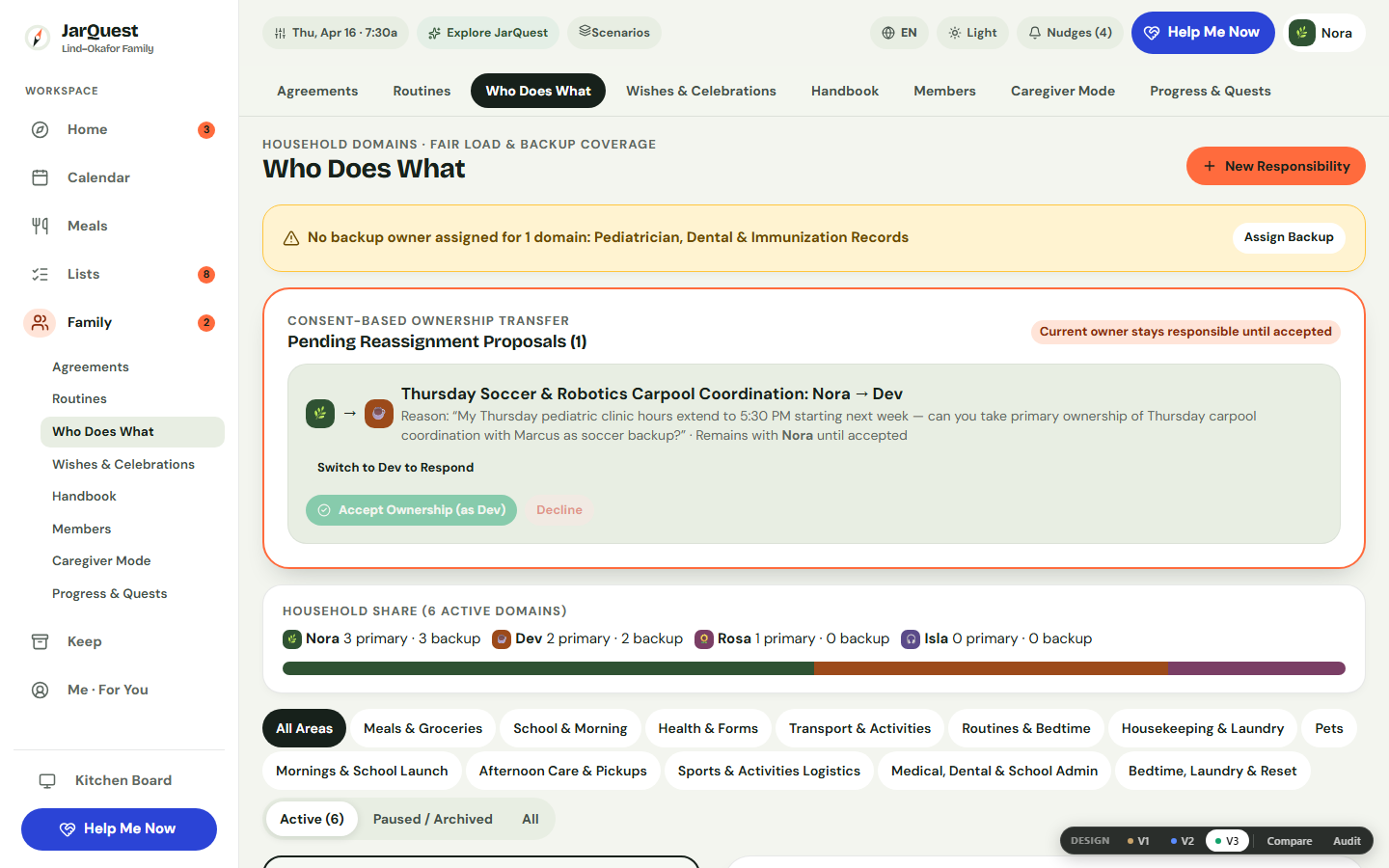
Step 1: Assign Primary & Backup Owners and Propose Consent Handoffs
Open Family → Who Does What. Select any recurring domain to see its Primary Owner, Backup Owner, schedule window, and Minimum Standard notes. When a schedule conflict arises, click Propose Handoff—the item stays visibly marked Pending until the receiving adult accepts.
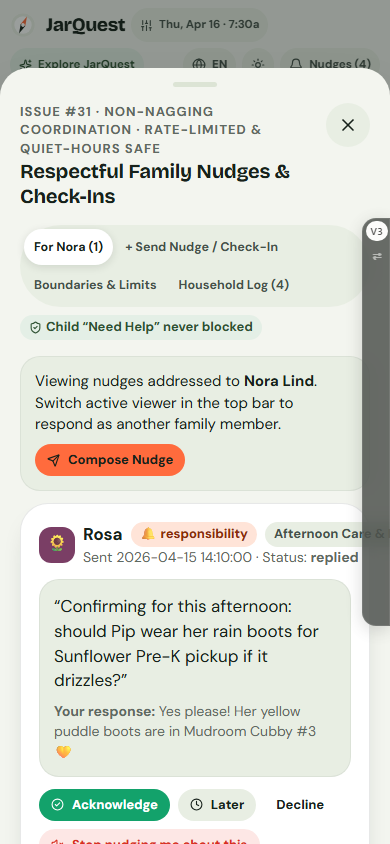
Step 2: Send a Respectful Nudge Instead of a Nagging Text
On mobile (390px), open the Respectful Nudges drawer from Daily Compass. Choose a kind tone preset (Gentle Reminder, Need a Hand, or Thank You), attach the specific responsibility context, and let JarQuest enforce quiet-hour and cooldown protections automatically.
Honest Limitations & Planned Features
- What JarQuest reduces: Unspoken assumptions over who owns recurring loops, forgotten prep details during handoffs, and reminder fatigue.
- What JarQuest cannot guarantee: Software cannot replace good-faith communication between partners or create extra hours in an overloaded workweek.
- Prototype vs. Production Status: Primary/backup responsibility ownership, consent handoffs (
Pending → Accepted), Respectful Nudges with cooldown guards, and Daily Compass ownership filters are verified in the V3.4.1 prototype. Multi-device push delivery and authenticated server sessions are part of the upcoming production cloud release.
Frequently Asked Questions
What is the difference between household chores and the family mental load?
Chores are the physical execution of a task—like driving to soccer practice or running the washing machine. The mental load is the cognitive work before and after: noticing the schedule change, checking that the uniform is clean, and arranging backup pickup if a meeting runs late.
How do I stop stepping in when my partner forgets a task they agreed to own?
Put the schedule and 3-bullet Minimum Standard of Care into your shared Who Does What view (or printed fridge charter) and agree on a 14-day hands-off window. Unless safety is involved, let the external system remind them rather than stepping in early.
How does this work for solo parents?
For solo parents, relief comes from externalizing working memory—moving recurring checklists out of your head onto Daily Compass and using Caregiver Mode / Printable Briefs so grandparents or sitters can step in without a 20-minute verbal briefing.
Related Guides & Contextual Next Step
- Related Guide 1: Family Responsibilities Chart: Who Does What
- Related Guide 2: Shared Family Calendar for School Pickups & Handoffs
- Related Guide 3: When You’re an Overwhelmed Parent: How to Make Today Easier
- Free Printable Utility: Print a Household Responsibility & Caregiver Sheet
- Explore the Feature: See Who Does What & Family Agreements in JarQuest