Bedtime Resistance in Kids: How to End Nightly Negotiations (Ages 3–10)
Tired of 8:30 PM bedtime battles and endless requests for water? Use this 4-step visual bedtime wind-down routine and calm de-escalation script.
Short Answer
By 8:00 PM, both your child’s impulse control and your own patience are running low. When bedtime turns into forty minutes of bargaining—"One more book, I'm thirsty, my blanket feels weird"—the solution is to replace verbal negotiation with a short, predictable 4-step landing strip where the child gets controlled micro-choices inside a fixed boundary.
You can calm tonight’s bedtime without any app using five practical steps:
- Front-load "Last Call" needs into Steps 1–3 (water sip, bathroom visit, and tomorrow’s clothes happen before stories, not after lights-out).
- Keep the visual bedtime sequence to 4 fixed steps: 1. Dock Devices & 5-Min Toy Reset → 2. Warm Wash & Pajamas → 3. Teeth, Toilet & Water Sip → 4. Two Stories & Lights Dim.
- Give your child one real choice inside each step ("Blue dinosaur pajamas or striped pajamas?" rather than "Put your pajamas on now").
- Use a low-voice, 1-sentence "Steady Boundary" script when stalling starts after stories: "It is rest time now; you are safe, and we wrote your question on the breakfast pad for tomorrow."
- Have a "Tired Night Shortcut" ready for late evenings: skip the bath and do a 10-minute Pajamas + Teeth + One Short Story version without guilt.
Why Families Encounter This Problem
Bedtime resistance is often a collision between separation from connection, unmet autonomy, and overtightened evening schedules.
All day, children follow adult instructions at school or daycare. After dinner, they finally get relaxed time with their parents—and then an adult announces, "Stop playing, brush your teeth, and lie in a dark room alone." Stalling is a natural attempt to extend connection and control. Meanwhile, tired parents see their final hour of rest disappearing and resort to rushed warnings ("No stories if you don't hurry!") that heighten frustration and delay sleep further.
Realistic Household Example
Household: Two children—Pip (age 4, pre-reader) and Theo (age 8)—with one parent handling bedtime solo on Tuesdays and Thursdays.
- Before: Cartoons ran until 7:45 PM, triggering a struggle at shutoff and teeth-brushing arguments until 8:35 PM.
- After restructuring the evening rhythm:
- 7:15 PM (Screen-Off & Floor Reset): Screens dock in the kitchen before bathroom steps begin, bridged by 10 minutes of LEGO or drawing.
- 7:30 PM (Shared Hygiene Window): Pip uses a 4-picture pebble card (Pajamas, Teeth, Water Sip, Pick 2 Books). Theo completes his evening steps (Backpack check, Pajamas, Teeth, 15 min reading).
- 7:50–8:10 PM (Connection Anchor): Because hygiene finishes before reading, story time stays calm and protected.
Practical Step-by-Step Solution Requiring No App
- Separate screen shutoff from bedroom entry by at least 30 minutes. Turning off a game and expecting a child to lie still two minutes later frequently triggers pushback.
- Post a 4-step visual bedtime card at child height in the hallway:
- Step 1: Tomorrow Ready (3 min) — Dirty clothes in hamper, tomorrow’s outfit laid out.
- Step 2: Pajamas & Wash (10 min) — Child chooses between two pajama options.
- Step 3: Teeth, Toilet & Last Sip of Water (5 min) — Explicitly check off a sip of water before entering the bedroom so "I'm thirsty" is already handled.
- Step 4: Cozy Connection (15 min) — Two picture books (ages 3–6) or 15 minutes of reading/quiet chat (ages 7–10).
- Keep a "Bedtime Parking Lot" notepad by the bedroom door. When an 8-year-old remembers an urgent question the moment lights go out, write it down in 10 seconds ("Saved on the breakfast pad for tomorrow morning") so they can let go of it.
- Use one calm, predictable response for post-bedtime curtain calls. Keep hallway lights dim, avoid lectures, and walk them back with the same phrase: "Check-in is finished; it's sleep time now. I love you, see you in the morning."
- Keep bedtime affection unconditional. Even if teeth brushing was bumpy, still give a calm hug at lights-out and adjust timing tomorrow.
Printable / Copyable Template
Copy this 4-step bedtime checklist or print an illustrated version in our Free No-Login Printable Routine & Caregiver Generator:
CALM BEDTIME WIND-DOWN CARD (Lights Dim Target: ____:____ PM)
[ ] 1. Tomorrow Reset: Devices docked in kitchen + clothes in hamper
[ ] 2. Cozy Pajamas: Warm wash/shower + pick tonight's pajamas
[ ] 3. Teeth, Toilet & Last Sip: 2-minute brush + bathroom + water sip
[ ] 4. Story & Snuggle Time: 2 books / 15 min reading together

Tonight's Choice (Kid Picks One!):
( ) Which 2 books we read   ( ) Which pajamas   ( ) Who turns on nightlight
Common Mistakes & What to Do When the Initial Approach Fails
- Mistake 1: Threatening to cancel bedtime stories mid-standoff. Saying "No books tonight!" often escalates tears—leaving you with a longer battle and unbrushed teeth. Offer a playful bridge instead ("Hop like a frog or walk like a robot to the sink?").
- Mistake 2: Starting 20 minutes too late. Watch for the "second wind" window around 8:00 PM when overtiredness looks like hyperactivity. Moving Step 1 earlier by 15 minutes often solves the stall.
- Mistake 3: Using bright screens in bed. Keep tablets out of the bed itself, or use paper cards / warm dark mode in the hallway.
- When NOT to use this approach: If a child has new nightmares, separation distress, fever, or ear/tooth pain, comfort them directly and consult a pediatrician rather than treating calls as stalling.
How JarQuest Can Help
JarQuest supports calmer evenings in three ways:
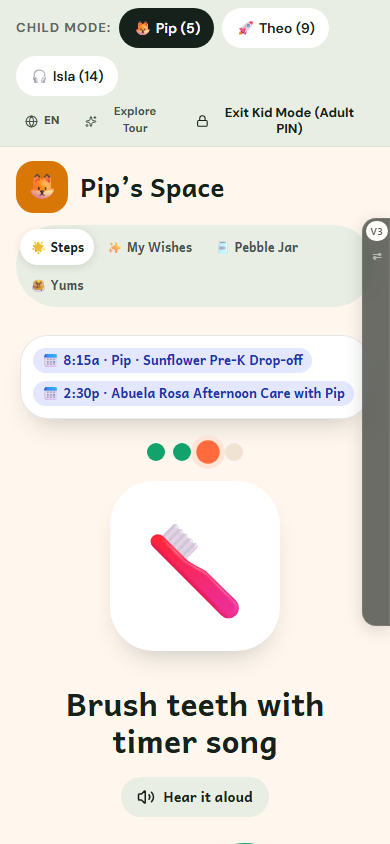
- Pre-Reader Picture Mode: Young children (Pip, age 4) see one calm illustration at a time with read-aloud audio and a pebble trail.
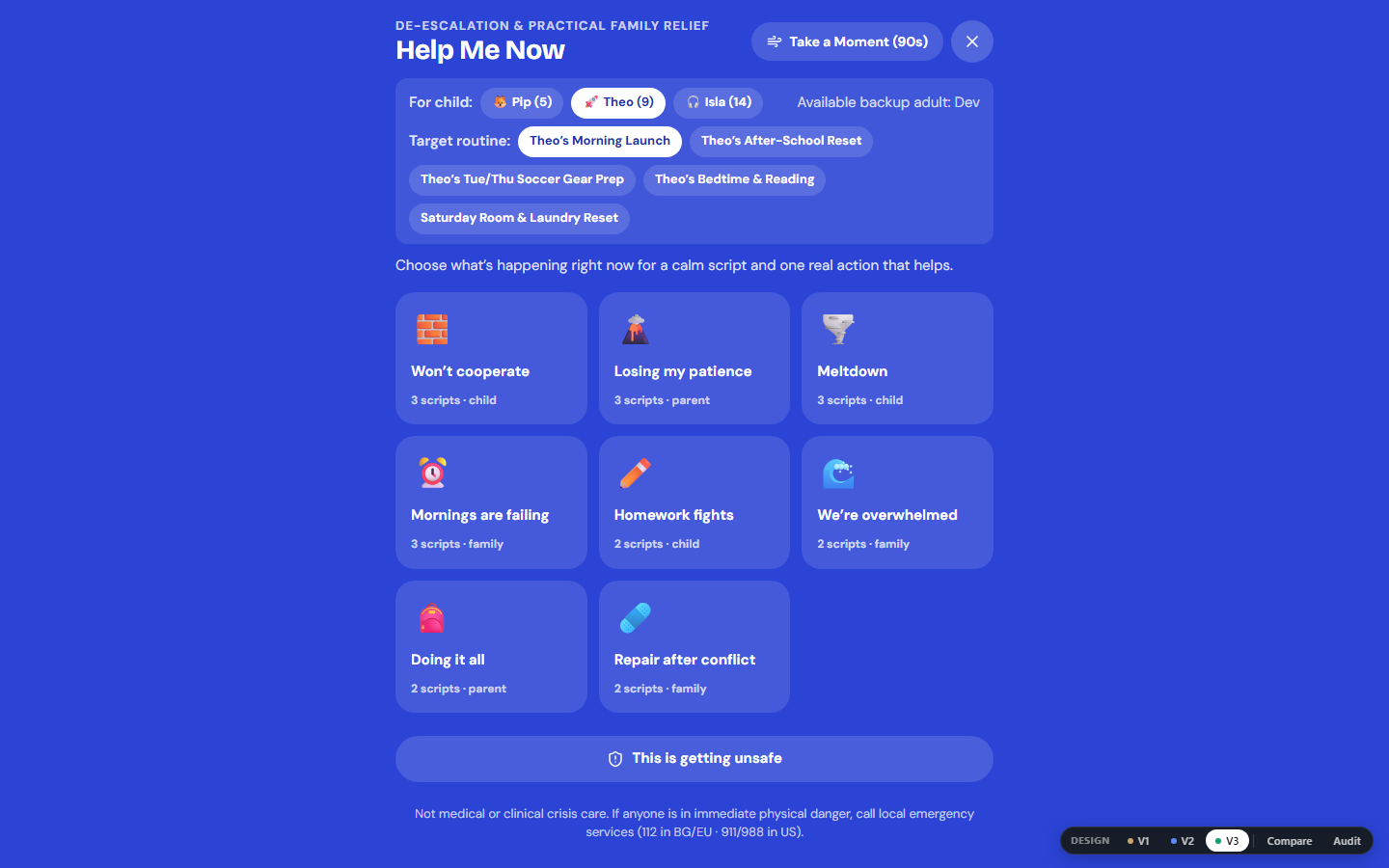
- One-Tap "Help Me Now" De-Escalation: Gives a tired parent an immediate What to do now → What to say → What to do next script plus a 1-tap button to trim tonight’s optional routine steps without breaking streaks.
- Sunroom Warm Dark Mode: Switches the interface to a low-glare forest-slate palette at night.
Step-by-Step JarQuest Setup (Interactive Prototype Walkthrough)
Product Status Note: All screenshots below are captured from the functioning JarQuest Sunroom V3.4.1 interactive prototype.
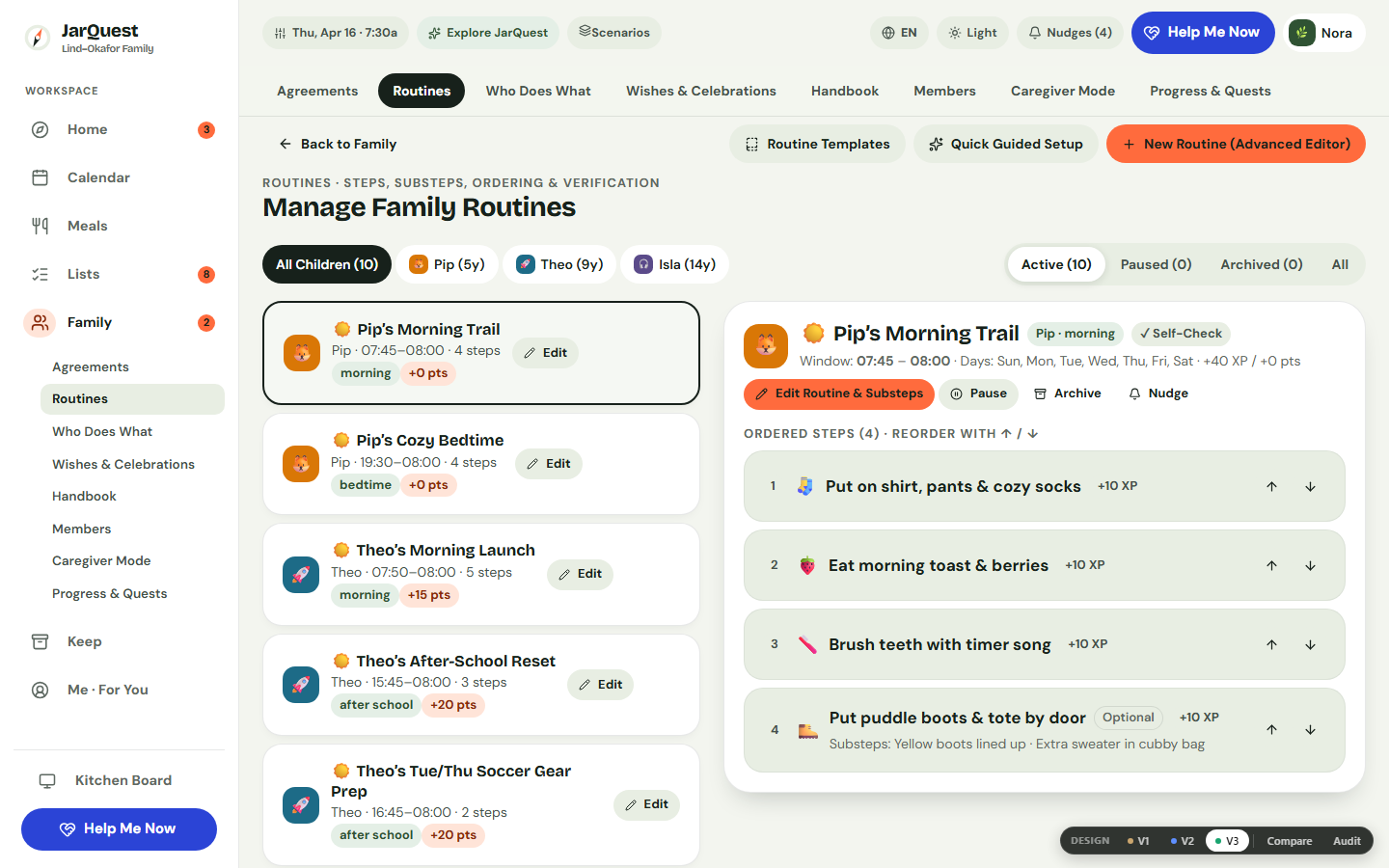
Step 1: Configure a Short Evening Routine in Family → Routines
Open Family → Routines, set the window to Evening or Bedtime, keep the list to 3–4 steps, and set "Need Help" Behavior to Open Calm Playbook + Alert Helper.
Step 2: Use Picture Mode for Young Kids on a Shared Device
In Kid Mode, select Pip. Each bedtime step appears as a large icon with a pebble trail and read-aloud button.
Step 3: Open "Help Me Now" When Bedtime Stalls
Tap Help Me Now from any parent screen to read a calm 3-part bedtime script, cycle through alternative ideas, or trim optional steps for tonight only.
Honest Limitations & Planned Features
- What JarQuest reduces: Nightly decision fatigue over what comes next and harsh words spoken when a parent is exhausted.
- What JarQuest cannot guarantee: Software cannot make an overtired child fall asleep on command or replace pediatric advice for sleep concerns.
- Prototype vs. Production Status: Bedtime routines, pre-reader picture mode, and Help Me Now routine trimming are verified in the V3.4.1 prototype. Cloud account sync and push notifications are part of the upcoming production cloud release.
Frequently Asked Questions
How long should a child’s bedtime routine take?
For ages 3 to 10, 20 to 30 minutes (including 10–15 minutes of reading) works well for most families. Longer routines usually mean daytime chores have crept into bedtime.
What if two siblings have different bedtimes?
Run Steps 1–3 (reset, pajamas, teeth) together at the earlier time so the house gets quiet at once, then give the older sibling 30 minutes of quiet reading in their room.
Should my child look at a screen to check off bedtime steps?
If a screen winds your child up, print the 4-step card using our Free Printable Generator and let the parent mark the routine complete afterward.
Related Guides & Contextual Next Step
- Related Guide 1: How to Build a Kids Morning Routine Without Nagging
- Related Guide 2: Screen-Time Transitions Without Meltdowns
- Related Guide 3: Grandparent & Babysitter Bedtime Routine Instructions
- Free Printable Utility: Print the 4-Step Bedtime Wind-Down Card
- Explore the Feature: See Visual Routines & Pre-Reader Mode in JarQuest